
Africa Daily Economic Briefing — 02 October 2026
Global yields and oil remained elevated at the 1 October close, while South African activity indicators improved and Nigeria shifted its policy message from reform to delivery.
Executive Summary
African economies begin the day facing a difficult external mix: global borrowing costs remain near multi-decade highs and oil has moved back above US$100 a barrel. The US 10-year Treasury yield ended yesterday’s session near 5.24% after touching 5.36%, while December Brent futures gained 4.5% to US$102.47. The International Monetary Fund (IMF) has said bond markets continued to function in line with prevailing conditions but warned that the energy shock was not yet over.
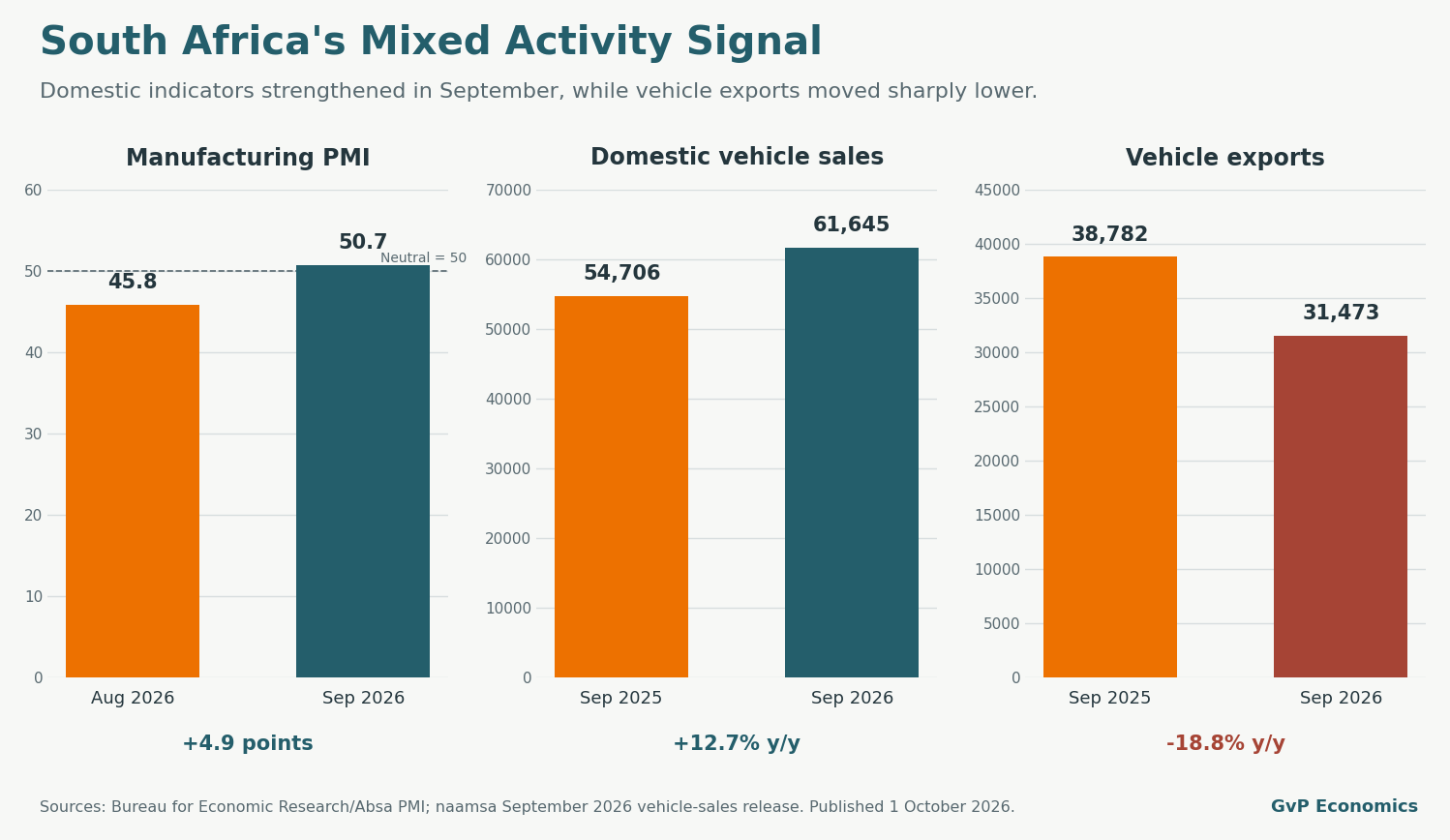
South Africa’s domestic indicators were more encouraging. The Absa Manufacturing Purchasing Managers’ Index rose from 45.8 in August to 50.7 in September, moving above the neutral 50-point threshold after three months of contraction. New-vehicle sales increased 12.7% year on year to 61,645 units. The export side, however, was weaker: vehicle exports fell 18.8% to 31,473 units, showing that stronger domestic demand is not yet matched by external manufacturing momentum.
In Nigeria, President Bola Tinubu used his Independence Day address to declare a transition from economic reform to shared prosperity. The government’s macroeconomic case rests on growth above 4%, lower inflation, rebuilt reserves and more than US$6 billion in non-oil export revenue in 2025. The policy test is now transmission: whether stabilisation lowers food, transport, power and credit costs for households and firms.
Key Developments
1. Global yields and oil keep African financing and inflation risks elevated
The US 10-year Treasury yield rose as high as 5.36% on 1 October before ending near 5.24%, still above 20-year highs. The move followed the largest quarterly rise in the benchmark yield this century. The IMF said global bond markets remained orderly, but the scale and speed of the repricing matter for African sovereigns because US Treasury yields anchor international borrowing costs.
Energy added a second external pressure. December Brent crude futures closed 4.5% higher at US$102.47 a barrel. The IMF reported that diesel, petrol and jet-fuel prices were between 60% and 97% above pre-conflict levels, reflecting the Middle East conflict and limited global refining capacity.
Why it Matters: Higher benchmark yields can increase the cost of refinancing Eurobonds and discourage portfolio flows to emerging markets. Oil-importing African economies face a parallel deterioration in trade balances, transport costs and inflation. Commodity exporters may receive some revenue support, but refined-fuel costs can still rise even in oil-producing economies with limited refining capacity.
2. South African manufacturing returns to expansion, but vehicle exports weaken
The seasonally adjusted Absa Manufacturing PMI rose by 4.9 points to 50.7 in September, from 45.8 in August. The index moved above 50 for the first time after three consecutive months in contractionary territory. New sales orders returned to expansion and business activity recovered most of August’s steep decline.
The vehicle market told a similarly positive domestic story. New-vehicle sales increased 12.7% year on year to 61,645 units in September, with passenger-car sales rising 14.7% to 44,291. Sales over the first nine months of 2026 reached 492,201 units, 12.5% above the comparable 2025 period.
The external picture was weaker. Vehicle exports fell 18.8% year on year to 31,473 units in September and were 10.0% lower over the first nine months of 2026. This divergence suggests that domestic demand and product competition are supporting sales while external market and trade conditions continue to constrain a major manufactured-export industry.
Why it Matters: The PMI rebound reduces the risk of another very weak manufacturing month, but one positive reading does not establish a durable recovery. Sustained improvement will require stronger production, orders and exports, especially as higher fuel and financing costs pressure margins.
3. Nigeria shifts the policy message from reform to shared prosperity
President Tinubu’s Independence Day address argued that Nigeria had moved beyond the emergency phase of reform and should now focus on lowering living costs, expanding productive employment and spreading the gains from stabilisation. He said the economy had grown by more than 4% in 2026, inflation had fallen from its peak, foreign reserves had been rebuilt and 2025 non-oil export revenue exceeded US$6 billion.
Official data provide partial support for the stabilisation narrative. Real GDP grew 4.43% year-on-year in the second quarter of 2026, while the Central Bank of Nigeria’s latest policy material places inflation at 15.39%. However, public debt stood at approximately N166.79 trillion at end-June, up from about N159.0 trillion at end-March. Commercial borrowing costs also remain high despite the central bank’s September reset of the monetary policy rate to 23%.
Why it Matters: Nigeria’s next economic phase will be judged less by directional improvement in headline indicators than by transmission. Lower logistics, energy and finance costs would support businesses and households; weak transmission would leave a gap between macroeconomic stabilisation and lived economic conditions.
Country Watch
South Africa
Yesterday’s data prints offered a stronger signal from domestic demand than from exports. Manufacturing sentiment returned marginally to expansion and vehicle sales remained robust, but falling vehicle exports point to external weakness and potential pressure on factory output and employment.
Markets moved in the opposite direction. The FTSE/JSE All Share Index closed 0.69% lower at 107,763.09 and the Top 40 fell 0.61% to 100,172.67. At 19:00 SAST, the rand was quoted at R16.67 per US dollar, 1.59% weaker on the day, as higher global yields and oil prices weighed on the domestic risk outlook.
The South African Reserve Bank also appointed economist Franz Ruch as Adviser to the Governors and the seventh member of the Monetary Policy Committee, effective 1 October 2026. The appointment adds technical capacity but does not by itself signal a change in the policy stance.
Nigeria
The President’s address set a clear delivery benchmark: reduce the cost of producing and transporting goods, expand reliable power and infrastructure, improve access to credit and convert stabilisation into jobs. Fiscal discipline will remain important because rising public debt and expensive domestic financing can crowd out the investment required to deliver those objectives.
Markets and Commodities
| Indicator | Yesterday | Daily Movement |
|---|---|---|
| US 10-year Treasury Yield | 5.244% | -6.7 basis points |
| S&P 500 | 7,670.36 | +0.3% |
| Brent Crude | US$102.47/barrel | +4.5% |
| FTSE/JSE All Share | 107,763.09 | -0.69% |
| FTSE/JSE Top 40 | 100,172.67 | -0.61% |
| Rand/US dollar | R16.67/US$ | Rand 1.59% weaker |
| Gold | US$4,177.63/oz | +0.48% |
| Platinum | US$1,721.60/oz | +1.39% |
The main cross-market signal is not the modest gain in US equities; it is the combination of a US 10-year yield above 5%, Brent above US$100 and a weaker rand. For African policymakers and businesses, that mix means dearer dollar funding, more expensive energy imports and renewed pressure on transport and production costs.
Policy Implications
- Debt managers should prioritise refinancing risk. High global yields make maturity profiles, foreign-currency exposure and cash buffers more important than headline debt ratios alone.
- Oil-importing economies need targeted responses. Broad fuel subsidies would weaken fiscal positions; temporary, targeted support and credible transport or social-protection measures are less distortionary.
- South Africa’s manufacturing rebound needs confirmation. Policymakers should watch actual production, new orders and export volumes before treating September’s PMI as a turning point.
- Trade competitiveness remains a constraint. South Africa’s strong vehicle sales alongside falling exports reinforce the need for reliable logistics, predictable trade access and competitive electricity and freight costs.
- Nigeria’s policy challenge is transmission. Lower inflation and stronger growth will matter politically and economically only when they improve real incomes, financing conditions and business operating costs.
- Revenue authorities should protect the productive base. Stronger compliance and digital administration can raise revenue, but high financing and logistics costs argue against measures that unnecessarily constrain formal firms.
What to Watch Next
- The US September employment report and its effect on Federal Reserve expectations, Treasury yields and the dollar.
- The euro-area September inflation flash estimate and its implications for global rate expectations.
- Whether South Africa’s stronger PMI is followed by gains in official manufacturing production and export orders.
- The rand and domestic fuel-price outlook after Brent closed above US$100.
- Implementation detail behind Nigeria’s promised reductions in food, transport, power and credit costs.
- Any quantified investment or beneficiation commitments arising from South Africa’s Steenkampskraal critical-minerals visit on 2 October.